Natascha Rommens
  25/08/2026
The Flemish games sector achieved a new milestone in 2025 with a record turnover of 76.5 million euros and 728 Full-Time Equivalents (FTE). Although the sector has grown by nearly 30 percent in two years, the industry stands at an important crossroads. Behind the record figures lies a harsh economic reality: Flemish game studios remain small and struggle to break through internationally due to significantly rising costs and a chronic lack of capital. To take the step toward economic stability, the sector is launching a clear call for targeted funding and flexible growth frameworks that support both large production teams and compact, high-quality IP studios.
Grab the main takeaways of the report below or download the full report right here.

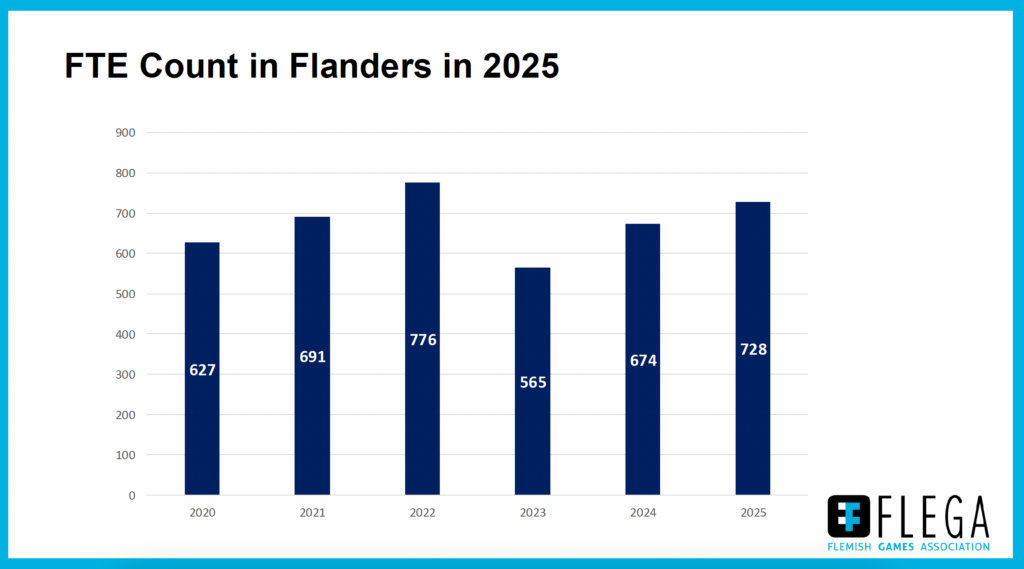
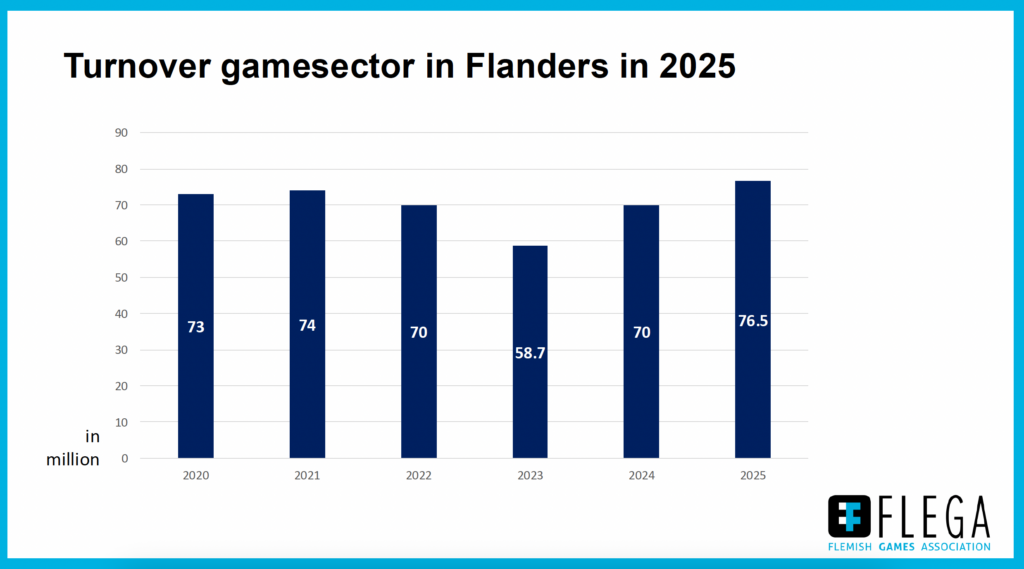
At first glance, the 2025 figures show a sector in full bloom. Total turnover rose from 59 million euros in 2023 to 76.5 million euros in 2025. The number of active game companies in Flanders climbed to 145 studios, an increase of over 13 percent year-on-year. On a global stage of layoffs and downsizing, these figures are a beautiful achievement. Yet, FLEGA views the optimistic trend with caution. Employment growth, which took a spectacular spurt of nearly 20 percent in 2024, cooled down to a modest 7.9 percent in 2025 (728 FTE). The sector is in a critical consolidation phase.
Fiscal and financing limits
With 145 companies and 728 full-time workers, the average game studio in Flanders counts about five employees. To break through internationally, these studios do not all need to transform into massive employers. After all, high labor costs and fiscal pressure in Belgium do not allow for that. The sector features multiple growth models: on one hand, studios that scale up in headcount to support multiple and/or larger productions, and on the other hand, compact teams that realize high added value per employee through their own intellectual property (IP).
The challenge is that both models are currently hitting their limits. Average productivity has remained stagnant for three years at approximately 105,000 euros in turnover per FTE. For studios that want to expand, the capital for larger teams is often lacking. For the compact studios, there is a lack of financial independence to take risks with their own IP, forcing them too often to fall back on work-for-hire for third parties to cover running costs. The sector needs an framework that fully supports and stimulates both forms of growth.
The path to financial independence
The transition of young studios into resilient, financially independent enterprises requires a targeted strengthening of the capital market and the supporting ecosystem. Although the Flemish Audiovisual Fund (VAF) provides much-needed support in areas like the start-up and prototype phases and for high-risk productions, the real bottleneck occurs at the follow-up financing stage.
There is a pressing need for the mobilization of additional private capital. In addition, the federal Tax Shelter scheme for video games remains a crucial lever that, in practice today, still too often collides with administrative ambiguities. Further clarification in the form of a FAQ and optimization of this instrument is necessary to channel private capital into the sector more smoothly.
Finally, the key to success lies in providing tools and structurally guiding studios toward financial independence. By fully focusing on entrepreneurship, market analysis, and community building, studios can sustain not only their projects but also their business model; further develop their IP and become less vulnerable to external factors.
Sources
Every year, FLEGA conducts a survey of all companies active in game development and services in Flanders. FLEGA collaborated with the VAF Game knowledge centre to validate some of these figures.