Check out these awesome pictures of the winners of the National Lottery and VASCO contest. They had a great time at the Gaming Developer’s Conference that took place from March 14 to March 18 in San Francisco. They attended lots of seminars, got to experience virtual reality, played loads of game demos and visited famous San Francisco landmarks. In the evenings they enjoyed some great GDC parties. We think it’s safe to say that it was a dream come true.


Watch Flemish professor Bob De Schutter’s talk on ageism at GDC 2016
 David
 19/04/2016
David 19/04/2016 At the Game Developer’s Conference 2016 professor Bob De Schutter of Applied Game Design at Miami University, gave an excellent presentation: Beyond Ageism: Designing Meaningful Games for an Older Audience. The past couple of years he has been researching the kind of games people over 50 play.
His research suggests that older adults prefer games with exploration, social interaction and less focus on reflexes. The latter is possibly because our reflexes get slower as we age and therefore we’re likely to find games that rely on fast reflexes a tad frustrating. As we get older we are all likely to find some sort of disability in our lives, be it reduced visibility, problems with our hands or other disabilities. Building content with accessibility in mind is therefore an important consideration. Larger fonts, different coloured backgrounds etc. One piece of advice here is that it helps if these are options, rather than one size fits all solutions.

Farmville is the number 1 game played by women over 50.
The number of gamers over 50 will increase exponentially in the future, so it’s important for publishers to know that they should start paying more and more attention to this growing demographic. One of the possible reasons the target group is now largely overlooked might be due to the age of the developers themselves. Most of them are between the ages of 30-39. They grew up with gaming and turned their passion into a career. As they get older themselves they will hopefully start to realise that young people aren’t the only ones enjoying (and buying) games.
Aside from ageism, Bob De Schutter’s also discusses virtual worlds. The whole presentation is about an hour long, but it is well worth your time. Watch it for free on the GDC Vault website.
Support the Belgian RPG Healer’s Quest
David 14/04/2016
David 14/04/2016 Allow us to introduce you to Pablo Coma, a thirtyish year old Belgian graphical artist, game developer and music composer who has been working in the Smurfs’ Studio for the past 11 years and is now developing his own game Healer’s Quest in his spare time.
Healer’s Quest is a lighthearted RPG in which you play solely as the healer of a ragtag bunch of unfocused, greedy and highly amoral adventurers. The only match to their (very lacking) skills is their lousy temperament. They will rush head-first into combat, fall into the most obvious traps, get cursed, poisoned, or even killed. It is up to you to ensure they will endure the most grievous wounds and survive their ordeals.
Pablo recently launched a crowdfunding campaign for the game on Kickstarter. The idea is to get just enough funding to make a big push in the game’s development and deliver an alpha version as soon as possible. Funds raised through Kickstarter will mostly be used to get days-off from his work (around 60 of them) so he can finish the game before the end of the year.
You can help fund Healer’s Quest on Kickstarter, cast your vote to get the game greenlit on Steam or try it out immediately by downloading the playable demo for PC.
Video Games help forge lifelong friendships
David 12/04/2016
David 12/04/2016Online video games have become one of the most common places for teens to meet their peers and create lifelong friendships. According to a recent Pew Research Center survey of teens ages 13-17, 72% of all teenagers spend free time playing video games on a computer, game console or portable device, with 36 percent reporting they have made new friends through online gaming.
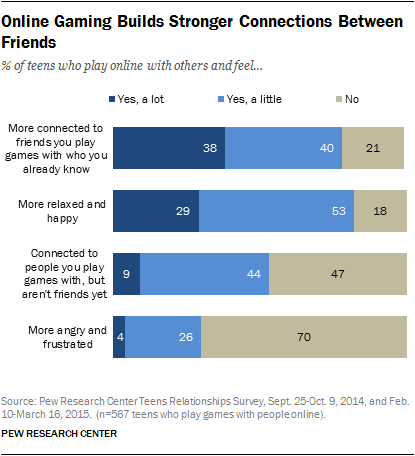
This is supported by others studies that indicate that video games help people connect better with existing and new friends, especially through voice chat. They feel a real sense of kinship with their online teammates. For many gamers it’s also an ideal way to keep in touch with friends. Sometimes they don’t even play, but just chat in the lobbies of the games. There are also countless stories of people finding true love while playing online games.
Researchers have been observing this trend for decades, prompting the academic world to refer to the online game environment as a ‘third space’, outside of the home and workplace, where people from different backgrounds come together to reinforce a sense of community. In some cases, players use online games as a way to have fun with friends and family they also see in the real world, or with other players whom they would never have the chance to meet otherwise.
 The online educational platform Kweeted.be, created by proud FLEGA member Die Keure (a printer/book publisher), has been nominated for the prestigious International London Book Fair Excellence Awards in the category ‘Educational Learning Resources Award’.
Kweeted.be will be taking on three other educational initiatives from different countries. Being nominated is a great honour in itself, because the nominees were selected from hundreds of entries judged by a group of international experts.
Kweetet.be is a completely safe online educational platform, based on actual school programs, with a wealth of exercises to enhance learning in the classroom and at home. Inside the realm of an impressive 3D world, kids play mini games, have adventures and pimp their avatars with the points (kwetons) they gather along the way. What’s more, the exercises are all part of great storylines written by experienced authors of youth literature. Next Tuesday, on April 12, the winner will be announced at the London Book Fair. We wish Die Keure the best of luck!

Get to know (the new) Control …
David 05/04/2016
David 05/04/2016Have you heard of Control yet? You certainly should have, because it’s the biggest game development community platform in the Benelux, responsible for Control Magazine (a print magazine), Control-online.nl (their digital home), Control500 (an international game development website), GameJobs.eu (a website dedicated fully to jobs within the games industry), internships.ctrl500.com (internships for students) and Control Conference (a big annual conference about game development, in cooperation with ImproVive).

Control was founded nine years ago by Matthijs Dierckx (former publisher) and Eric Bartelson (former editor-in-chief), as a print magazine for the Dutch games industry. Throughout the years many new events arose from the magazine like the annual Control Industry Dinner and the bimonthly Control Gamelab, which ran from 2011 to 2013. In recent years the focus has shifted towards the various news sites, the job portal and especially Control Conference.

Alessandra Otterlo
At the beginning of this year Alessandra Otterlo became the new owner and ‘showrunner’ of all activities of Control. Otterlo is certainly no stranger to the Dutch games industry. She has worked for companies and institutions like Playlogic, RANJ, the NLGD, the DGA and Palandin Studios. She was also involved in the creation of Control from the very beginning, so she knows all the ins and outs. In February she and her team launched the new style of Control, with very clear categories like News, Events, Out now! and many more (link in Dutch only).
Hot tip: Do you have something interesting to share with the editors of Control like the release of your newest game, a blogpost you want to share, an event everybody should know about … If so, we have some great news for you! You can fill out this Google Form to let them know they are missing out on a hot game related topic. Go ahead, don’t be shy!