The fifth edition of MEET & BUILDwill take place in Charleroi on November 23 from 10.30 until 19.00. Tickets for the free gaming conference are usually gone in a flash, so if you want to attend the birthday party you’d better not sleep on it. Secure your places now!
The organisation is celebrating this anniversary edition with no less than 30 speakers from around the world, filling up four cinema halls. Topics range from prototypes and financing to marketing and community management, so there’s a little something for everyone. And even though people keep telling us there’s no such thing as a free lunch, you’re getting a free lunch.
There’s a close collaboration with the Czech gaming industry this year, with six Czech speakers, such as Michaela Dvorak (Beat Saber), Lukas Kunce (Amanita Design), and Karel Moricky (Bohemia Interactive), and an exhibition dedicated to Czech games. With Yves Grolet (Appeal Studios), we also have some national pride on stage. You can check out the full program here.
The event comes highly recommended if you’re looking to gather and share knowledge with other industry professionals and game dev students. We’d like to especially encourage more Flemish developers and students to check this out, as it’s really a one-of-a-kind experience. So sign up and see you there!
We haven’t seen the inside of a classroom for many years, but we’re pretty positive technology has transformed the art of teaching quite a bit. You can learn all about the latest innovations in education at SETT (School Education Transformation Technology), taking place October 23 – 24 in Flanders Expo, Ghent, where games will play a special role.
If you’re on the prowl for new games, or you’d like to hear about new ways to implement them in your lessons, you should head down to the Game Square (link in Dutch). These Flemish developers are eagerly waiting to talk about their passion for game based learning.
De Stemmels
Cartamundi Digital will show you how to bring picture books to life with their Fundels platform and introduce you to De Stemmels, a new hybrid board game that’s being co-developed with Technopolis.
The free, online programming language ViKiD (link in Dutch), created by Strongly Typed Solutions, features modern concepts based on mathematics used by industry leading corporations. The integrated puzzle game guides children through the various possibilities of the STEM app, and before you know it they’ll get a taste for computer graphics, animation, and games programming.
There’s public demos of the platform on Wednesday at 10.30 and Thursday at 15.00. Other demos during those days include a session by Odoo (link in Dutch) to learn players key business principles, while Just Game IT (link in Dutch) presents a platform to gamify real life situations, such as surveillance of a building or working a forklift, for training purposes.
Embark on an epic journey to discover your talent in Kr8cht
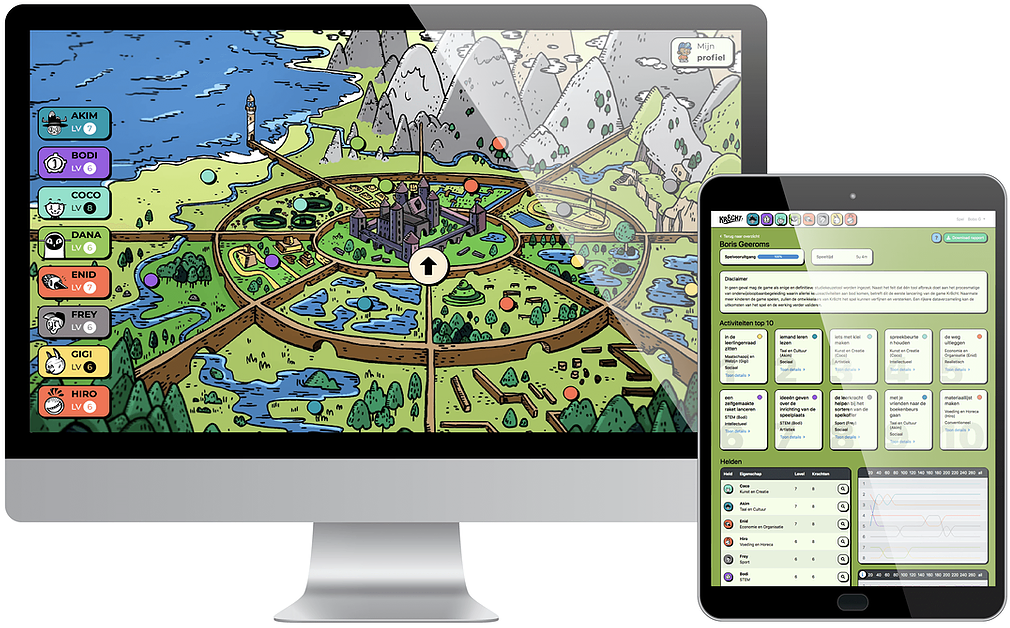
You’ll be able to find the innovative applications from Curious Cats (link in Dutch) at the imec booth. The team will be there to show off their portfolio including Ava & Trix, BULB, and the recently completed Kr8cht (link in Dutch), which helps children pick a field of study that suits them.
There’s more to SETT than just the technology fair though. Over the course of two days the event will serve up a conference with over 100 lectures and workshops aimed at (future) teachers, principals, IT coordinators and policy makers. With so much content on offer, you’d better plan ahead, so here’s the full schedule.
We’re very happy that video games are becoming a (more) common sight in the classroom and support all educators that want to explore the possibilities of the medium. Here’s hoping that a visit to SETT will work as an inspiration to keep pushing in that direction.
Whether it’s on this blog or through our social media channels, we can’t seem to shut up about the #BelgianGamesIndustry. It’s bubbling. It’s maturing. It’s growing. You know the mantra. On the other hand, we spend very little time explaining what working in our local industry is like. Who are the people behind these games? What magic do they pull off to create these amazing experiences? Time to try and change that.
In this two-part blog (with the second part up next month) we’ll go up close and personal with our beloved industry and take a closer look at the different roles you can play in it. Coming hot off the heels of the Women Code Festival 2019 in Brussels, this is an excellent moment to highlight the many possibilities local game development offers to anyone who’s eager to embrace it wholeheartedly.
While browsing the different profiles, please keep in mind that a summary like this is hardly exhaustive. On top of that, in smaller game companies roles will blend into each other as there’s simply not enough devs to cover all areas separately. More so than other software, creating video games is a collaborative effort: there’s no job more or less important. Collaboration and communication are key to successfully wrap up a project.
Programming
We like to talk about finished games in terms of experiences, but at the end of the day it’s a piece of software that needs to be programmed. Programmers or coders are the mathematical wizards that shape the game’s behaviour and create its logic. They can also create tools that the rest of the team can use during development.
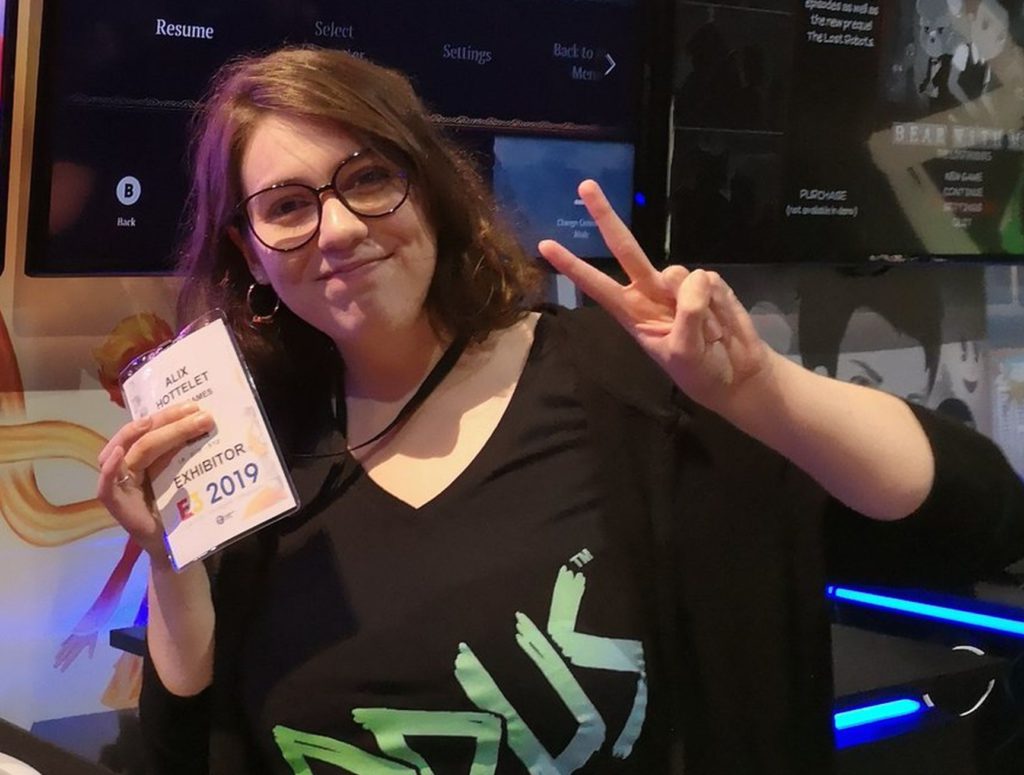
Before moving to Montreal just last week, Alix Hottelet was a gameplay programmer at eXiin, working on Ary & The Secret of Seasons. “I was in charge of routine programming, bug fixing and maintenance tasks but I also got to design the quest and dialogue system from scratch. One thing I loved about that job is that it allowed me to dabble in multiple aspects of the production, such as design and project management.”
Being a self-taught programmer in a world of people who went to fancy schools, she feels like she has to prove herself harder because she doesn’t have an established technical background. “To get into a programming job, people have to prove themselves throughout their career. This can get tiring for some, but I actually think it can help break down some prejudice around gender.”, noting that sometimes people automatically assume she’s an artist or producer, rather than a programmer.
Production
Working on games might be good fun, it’s also a great way to quickly burn through money. You’ll need a firm navigator to keep development on track in terms of time and money (which are pretty much the same thing.) Whether to call this person a producer or a project manager doesn’t really matter, as long as their Excel skills are up to snuff, and they have the ability to find compromises between different departments with different needs.
Iris Delafortry started out as a producer at Hubris VR developer Cyborn while it was still a small 3D production company. “When I graduated in photography and applied linguistics I knew that I wanted to work in a creative industry. I’m glad we’re now also in game production as I like the industry and the people a lot.” At Cyborn, she follows up specific projects and has input on team management and creating new business. Being around for quite some time, she’s also part of the management team where structure, culture, and policy are decided, and gets to attend a lot of interesting industry events.
Art
Games are a visual medium, so a striking art style can go a long way into getting your game noticed. Visual artists come in various sizes and specialties but we’ve tried to identify some main roles. Concept artists work closely with the design team to paint a broad picture of their ideas. They create 2D visual references and style guides the team can use to make sure there’s a coherence to the visuals.
3D artists use these drawings as a starting point to create the actual 3D assets for all objects and characters in the game, while 3D animators make sure everything’s moving like it should. Because the options of third party 3D engines like Unity or Unreal Engine in terms of animation are quite limited, animators often turn to special software or – if the budget allows that – motion capture. Last but not least, technical artists bridge the gap between artists and programmers. They ensure the flawless implementation of assets while respecting the artistic vision as well as the technical limitations of the game platform.
Pauline Marlière has a background in animation, but since she went freelance last year also works on game design. “My first big step in the games industry was the InnoGames jam back in August 2016 where my team and I made the first draft of Panoptic. One year later we created the studio Team Panoptes.” As a Women in Games ambassador, she’s quite fierce when it comes to her views on women entering the industry. “No one likes to admit it, but I don’t think Belgium is doing a better job than France or the US at the moment.” She advises up and coming female developers to find and join a sisterhood/women-only group about game development if they want to be able to talk freely.
While this is hard to hear, we both respect and regret that these feelings are floating around in our community. In an effort to create an even playing field and put talent first, we’d like all people interested in joining the #BelgianGamesIndustry to reach out. Please send us your resumes so we can distribute these through our channels among our developers. It’s the first step towards making our local community more diverse, more creative and more powerful as a result.
Earlier this week, VAF|GAME announced the results of their latest funding call. As the year advances and the budget dwindles, the commissions once again had to make some tough cuts, which resulted in just five projects getting funding.
As our industry continues to grow, we have to accept that the bar to secure funding is being raised with every new call and it was no different this time.
Here’s the projects that managed to safely land on the other side.
Pre-production
The sole project out of many submissions to receive support for pre-production was Nanopixel who received € 41.600 for VR Opleiding Scheidsrechters (serious game)
Production
Warcave nailed its hearing and was granted a whopping € 200.000 to tell the story of Black Legend, a promising turn-based strategy role playing set in a fantasy version of the Dutch Golden Age (entertainment game)
Triangle Factory received € 110.126 for their online multiplayer VR shooter Hyper Dash (entertainment game)
LuGus Studios hacked their way into the commission mainframe to award themselves € 31.874 for Midnight Protocol. Good thing they would’ve gotten the money anyway (entertainment game)
Midnight Protocol couldn’t be more different from previous LuGus Studios efforts
Promotion
Charming platformer Stitchy 2 by Polygoat was the only game to receive € 18.000 promotion support this time around (entertainment game).
Congratulations to all the studios that secured funding and support. We hope you’ll be able to use the extra resources to craft some truly wonderful games and help expand the international renown of the #BelgianGamesIndustry.
The deadline for the final call of the year has already passed. If you’re planning to secure a slice of next year’s funding budget, VAF|GAME is expecting your submission by January 28. Good luck!
Black holes are a tad crazy aren’t they? Swallowing whole planets along with the hopes of millions of kids just wanting to play Fortnite on a regular Sunday. Nuts! Still, we’ll be using one to suck up all your tasty BelgianGameAwards20 submissions.
We’re not looking to mess up the universe though, so there’s rules! You can read them in full here, but the most important thing’s to toss in your submission before November 15. After that, we’ll throw our judges (which we’ll announce at a later date) in there. If all goes well they’ll burst through the singularity and emerge with the names of the winners.
For those who’ve competed last year and may feel it’s perfectly safe to toy with infinite gravitational power without reading the bleeping manual: there’s some tweaks here and there. For example, you won’t need to pick the category in which to compete. With the exception of Best Studio (which you’ll be able to enter for specifically via the same submission form), the judges will assign the games to different categories and pick the nominees, which will be announced early next year.
Want to follow in the footsteps of these games? You know what to do!
Just like last year, each submission will be charged a € 25 fee, but a nomination nets you 3 tickets for the award show (worth € 75) and a chance to showcase your nominated game(s) during the 1UP Conference on February 21. Missed out on a nomination? Your €25 submission fee will be converted into a free ticket to attend the award show. If you want more friends and family see you take home the trophy, you can always get more tickets to the award show.
People like winning, so there’s more awards (scroll down) to hand out this year during the award ceremony on February 21 at 1UP 2020. There’s a brand new Audience award, Student Game of the Year is now open to all Belgian student projects and one lucky devil is even getting honoured for his/her contributions to the #BelgianGamesIndustry as a whole. It’s sure to become another magical night and a true celebration of what makes our industry tick. There’s still plenty of surprises in store and we will unveil more in the weeks and months to come.
Sky’s the limit!
In conclusion: if you’re a game developer based in Belgium that’s released a game this year and you feel like you could totally crush this, please direct your gaze this way and enter the competition. The rest is up to the universe. Good luck!
This celebration of #BelgianGamesIndustry success wouldn’t be possible without the valued support of WALGA, ScreenBrussels, VAF|GAME, Flanders DC, and Cronos Interactive.
Hoverloop developer and FLEGA family member Not a Company has launched a brand new website last week. Their multiplayer arcade arena combat game that’s currently out on Steam Early Access still takes center stage, but they’ve also added a sizeable work for hire section.
The offered services range from creating 3D assets, concept art, and VFX to programming support. The team has a proven track record with Unreal Engine 4, but also has Unity experience and aims to be versatile to adapt to any specific project needs. Game developers at heart, Not a Company is looking to put their various skill sets to use in other professional sectors that benefit from high quality 3D or VR applications.
Being part of the Cronos Interactive network, the developer duo that primarily offers art support can easily add other talented developer profiles, such as AR/VR developers, to the project. Have a look at some of the work they’ve done to convince yourself Not a Company is the company you’re looking for to support your next project.
 Christophe De bont
 25/10/2019