Good news for video game developers that are working on a project that covers sustainable or humanitarian themes. The Federal Ministry of Foreign Affairs, Foreign Trade and Development Cooperation has opened its tender for audiovisual support (link in Dutch) to include video games for the first time.
The focus is on serious game productions with themes that cover human development issues, sustainable development goals, and have a global perspective. The supported projects are able to spark discussions and let students think about the presented issues. Next to a general outline of your video game project, you’ll also have to present a pedagogical file and distribution plan.
Applications will be weighed on a number of different criteria such as interactive content, impact, and visual aesthetics. The final score of your project will determine the amount of funding you’re eligibile for. For video games, the range is between € 15.000 and € 40.000. Production support also can’t surpass 50% of your total production budget.
Applications need to be filed through the government’s digital tender site before 18th March. As it’s the first time video games are eligible, we highly encourage you to take advantage of this opportunity if you can.
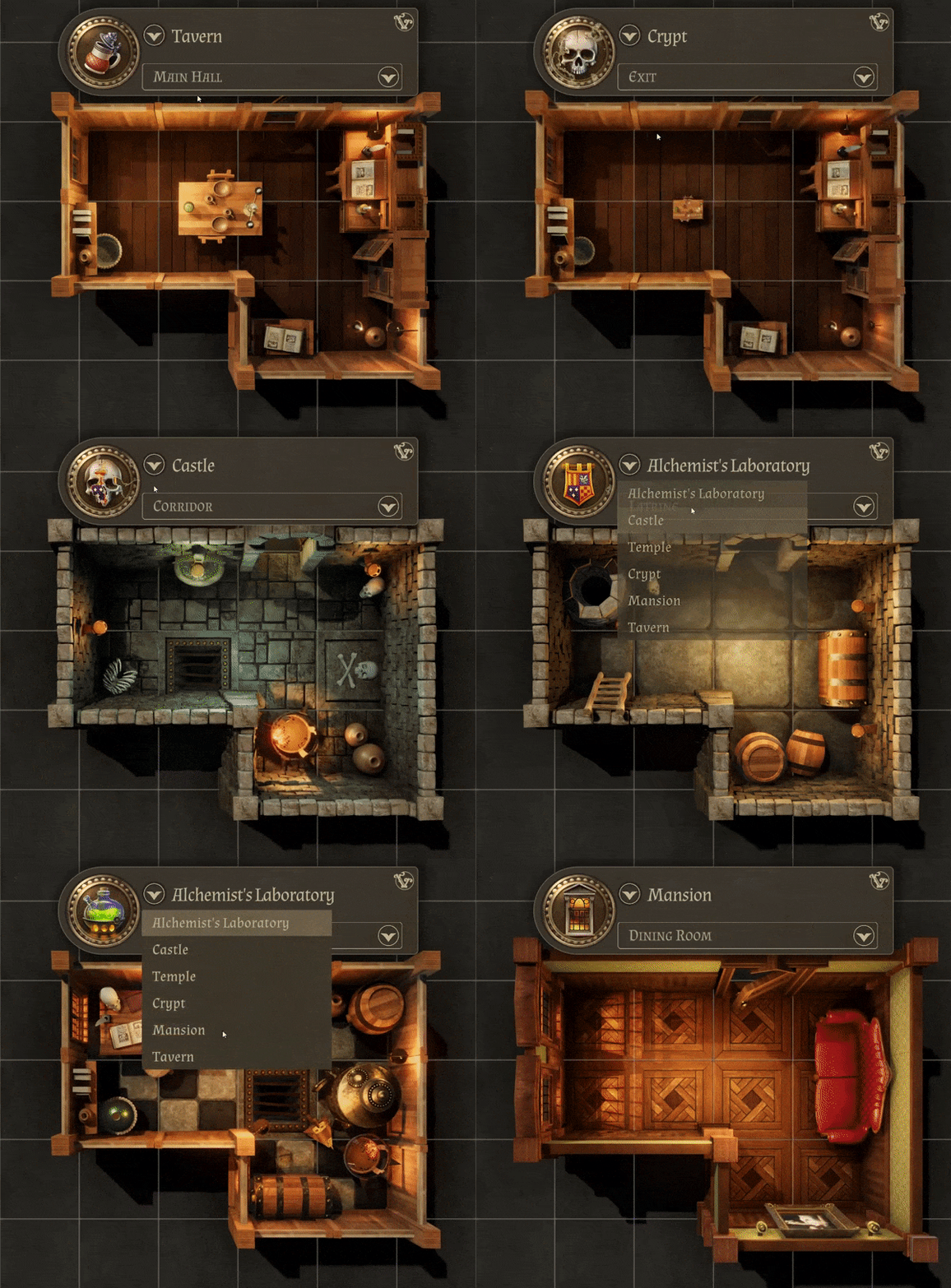
Before boring science rained on its parade, alchemy was an exciting field of study. Medieval researchers – let’s call them sorcerers – were hunting wild stuff such as the elixir of life or a way to transform ordinary metal into gold. In that sense, Dungeon Alchemist hasn’t completely stolen its name: the newest project by veteran developer Karel Crombecq and illustrator Wim De Hert sure has a magical knack for turning things into money.
Point in case: the AI-powered map-making software soared past its initial Kickstarter goal of € 45.000 in just three hours. At the time of writing 3198 backers have contributed € 137.156 to the project. It’s not hard to see why, either. The tool lets roleplayers swiftly create, print, share, and import all kinds of fantasy maps for their campaigns.
The ease with which rooms and objects magically pop into existence by simply drawing a shape feels satisfyingly reminiscent of games like Townscaper and Cloud Gardens. Being avid roleplaying fans themselves, the team knew creating high-quality content at such speeds is nothing short of a roleplayer’s wet dream.
Still, Karel Crombecq didn’t anticipate this kind of success: “I was quite convinced we had found a gap in the market, but you’re never sure how big the audience you’re gunning for really is. And then there’s still the question of being able to reach them. So yeah, we’re happily surprised!”
As the money keeps coming in, the team has prepared a range of stretch goals to grow the ambition of their project. Tricks and traps, Steam Workshop support, a winter theme, all kinds of watercourses, and more detailed objects have already been unlocked. Next up are villages and farms at € 140.000 and a lava theme at € 170.000. At an undisclosed number that’s probably € 200.000 Dungeon Alchemist will be infused with the alluring power of magic.
And beyond? Crombecq keeps his feet on the ground: “We’ve prepared stretch goals until € 500.000 but I’m not sure if that’s realistic. Kickstarter campaigns tend to slow down after the first few days, so I don’t think we’re going to quintuple the current amount. To me, everything above € 200.000 would be madness.”
There’s still 27 days to go though, so time will tell if that modesty is warranted. The way they go about gradually announcing the stretch goals might keep the community engaged to come back and perhaps up their pledge to reach for a particular interesting stretch goal.
If you’re interested to keep tabs on the campaign, you can do so on the Kickstarter page, but you might also join their Discord, or follow them on Twitter and Facebook. We for one will keep an eye out where this promising project will end up.
It’s 2021 and the fact that the idea of inclusivity still isn’t a given – even something we need to be constantly reminded of lest we should forget – already feels like some kind of failure. In an effort to raise awareness, not to soothe our soul but because we firmly believe inclusivity and diversity will result in a more creative and stronger #BelgianGamesIndustry, here are some events that try to improve this.
If you feel like you need to educate yourself on the subject, devcom is hosting the Call for Change Summit. In a series of workshops, panels and roundtables, you’ll learn about practical approaches to diversity, inclusion, and accessibility. It’s taking place all digital from 25th February until 26th February and all you have to do is sign up for free here.
The day after, on 27th February, you can also tune in to the digital edition of Meet & Build at 2.30 PM for Ally McLean’s talk on why inclusivity is key to making great games.
Next: a couple of organisations that do great work on these topics:
Represent (link in Dutch) is a campaign that fights for more diversity in audiovisual media. Without wanting to relegate it to a check list, they have published a guideline (link in Dutch) for a better inclusion of cultural diversity and people of color in audiovisual media.
WIFTM Belgium (link in Dutch) meanwhile is the Belgian branch of the international organisation that surfaced in 70s Hollywood and fights for the rights and equal inclusion of women in film, television, and media.
Victims of sexual harrassment or discrimination can reach out to De Genderkamer (link in Dutch) of de Vlaamse Ombudsdienst. You can safely reach them on the number 1700.
It’s a good thing these events, campaigns, and organisations exist, but they can’t take action in our place. So if you feel you can contribute to a level playing field for everyone and work towards a stronger #BelgianGamesIndustry based on equality for all, please take that action. Thank you.
There’s still no word on the return of physical games events, but thanks to the regular Steam Game Festival we’re getting our fair share of new and tasty video games. The winter edition, which hosts over 500 demos, is in full swing and there’s a couple of Belgian games competing for visibility. So let’s help them out a bit, shall we?
Start your journey on the Rogues, a quiet island group where you can go for a relaxing walk on the beach to empty your mind and … talk with a ghost that’s stuck in your head. Ghost on the Shore is the first commercial release of narrative game studio like Charlie and blends the best parts of The Chinese Room’s walking simulators and Firewatch’s interactive dialogue into a highly evocative narrative experience. By exploring the islands, you’ll learn more about the history of the people who lived there, and develop an emotional relation with the person inside of you.
A different kind of spooky is offered by the horror game Alisa. Chasing a criminal, Elite Royal Agent Alisa stumbles across a big victorian mansion, where she’ll have to fight for her life against an army of mechanised dolls. The game features a 90’s look and feel and recalls horror classics like Resident Evil and Alone in the Dark. Solo developer Casper Croes succesfully Kickstarted the project last year and is now working towards a late May release.
Every time we get a fresh look at Happy Volcano’s You Suck at Parking it looks better than before. The concept of sliding your car in the designated parking spaces as quickly as possible is so simple yet brilliant. Somewhere between What The Golf and TrackMania, the charming presentation (just look at that overworld!) equals the whacky gameplay. With its easy to learn, hard to master design and editor to create your own crazy levels, we can see a lot of people playing this for a very long time.
If you can tempt Magic: The Gathering creator Richard Garfield to work on your game, it seems to us like you’re doing something right. Roguebook is the next roguelike deck-builder by Faeria developers Abrakam. Inspired by genre progenitor Slay the Spire, it sees you travel through the pages of a magical book, splashing ink to reveal new opportunities on the map. Find gold, strengthen your deck, and above all, play your cards right to emerge victorious against the boss waiting at the end of each chapter. The game is published by Nacon and will release on 24th June.
The Steam Game Festival continues until 9th February 7 PM. Some demos might be up a bit longer, but why take the risk if you’ve got the weekend ahead of you?
PS: We carefully combed our way through the demos, but do give us a shout if we missed your game and we’ll gladly add it!
Good news for all of you that missed one of the coziest #BelgianGamesIndustry happenings on last year’s event calendar. For reasons obvious, Meet & Build had to be skipped, but the 2021 Belgian edition is on!
The way the world is right now it will be an all digital event on 27th February which means it’s never been easier to attend. There will be 13 talks in total: 6 conferences on all aspects of video games production (prototyping, financing, marketing, community management, …) and 7 talks on formations and jobs in the Belgian video game industry. Not counting the session by Yves Grolet (Appeal Studios), the former will be in English. For the latter you might have to brush up on your French.
Bastien Gorissen (Team Panoptes) and Dirk Van Welden (I-Illusions) tackle the quetion if there’s still a future for VR in video games
Australian Ally McLean on why inclusivity makes better games
Yves Grolet on how to launch your game studio and keep it afloat (FR)
a #BelgianGamesIndustry roundtable featuring our own David Verbruggen in conversation with WALGA’s Jean Gréban, Screenbrussel’s Marine Haverland, VAF’s Youri Loedts, Wallimages’s Domenico La Porta and GameMax’s Savine Moucheron.
As part of the 40th anniversary edition of the Brussels animation film festival Anima, Futuranima, a program of videos and online live events aimed at industry professionals and students, includes two interesting sessions on video games.
First off, on 15th of February at 7 PM there’s an online Brotaru. For those of you who aren’t in the loop: Brotaru is an informal, monthly gathering of video game developers. Students, amateurs and professionals alike are encouraged to present their projects to get valuable feedback and advice. The event will be hosted by sU developer Guillaume Bouckaert.
Then, on 18th of February at 10 AM there’s an interesting roundtable discussion about the use of Unreal Engine in animation films. Video games and animation are closer to each other than ever before and after examining the possibilities of Unity during a prior event, this time the focus is on the power of Unreal Engine. A session brought to you by Brotaru, screen.brussels and VAF.
 Christophe De bont
 17/02/2021